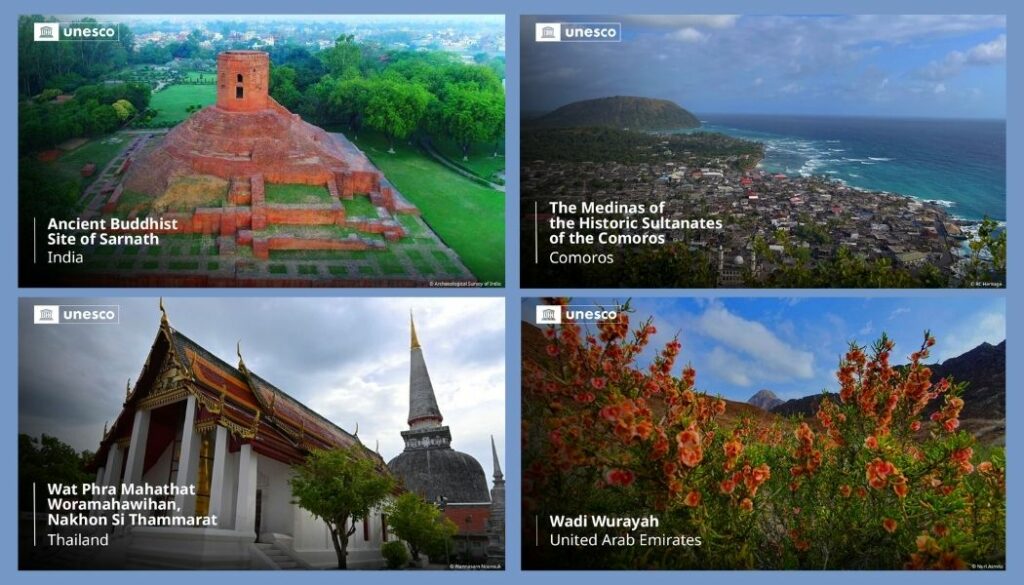
Four Indian Ocean Destinations Join UNESCO’s World Heritage List
Four remarkable sites across countries connected to the Indian Ocean region have been officially inscribed on the UNESCO World Heritage List during the 48th Session of the World Heritage Committee, held in 2026. The new inscriptions celebrate the region’s extraordinary natural landscapes, cultural heritage and centuries-old traditions, further strengthening its appeal as a world-class travel destination.
United Arab Emirates: Wadi Wurayah
Nestled within the Hajar Mountains in the Emirate of Fujairah, Wadi Wurayah is the UAE’s first mountain-protected area to gain World Heritage recognition. The site combines exceptional geological formations with outstanding biodiversity. Its rugged valleys, freshwater ecosystems and unique habitats support more than 1,000 recorded plant and animal species, including several that are globally threatened. The inscription highlights both the site’s scientific importance and its role as one of the Arabian Peninsula’s most valuable natural sanctuaries.
Comoros: The Medinas of the Historic Sultanates
The Medinas of the Historic Sultanates of the Comoros preserve the legacy of six historic towns that flourished through Indian Ocean maritime trade from the medieval period onwards. Their urban fabric reflects centuries of cultural exchange between Africa, the Middle East and Asia, while local traditions continue to shape daily life. The medinas stand out for their distinctive architecture, social organisation and living cultural heritage, illustrating the unique identity of the Comorian archipelago.
Thailand: Wat Phra Mahathat Woramahawihan
One of Southeast Asia’s most revered Buddhist monuments, Wat Phra Mahathat Woramahawihan in Nakhon Si Thammarat has served as a major spiritual centre for more than fifteen centuries. Its architecture and religious traditions bear witness to the exchange of ideas across the Indian Ocean, drawing influences from India, Sri Lanka, Java and the Mon Kingdom. Today, the temple remains an active place of worship, renowned for its sacred relics, annual religious ceremonies and the celebrated Nora dance tradition.
India: Ancient Buddhist Site of Sarnath
The Ancient Buddhist Site of Sarnath marks one of the most sacred places in Buddhism. It is traditionally recognised as the location where the Buddha delivered his first sermon after attaining enlightenment, laying the foundations of Buddhist teaching. Over the centuries, Sarnath developed into a flourishing centre of pilgrimage, learning and monastic life, with magnificent stupas, monasteries and temples. Its archaeological remains continue to attract pilgrims and visitors from around the world, reflecting its enduring spiritual significance.
Celebrating the Heritage of the Indian Ocean
Together, these four newly inscribed properties highlight the rich cultural and natural heritage of the Indian Ocean region, celebrating its biodiversity, historic cities, living traditions and archaeological legacy. Their inclusion on the UNESCO World Heritage List not only recognises their Outstanding Universal Value but also reinforces the importance of preserving the cultural and natural heritage that has connected civilizations across the Indian Ocean for centuries.
The inscriptions were approved during the 48th Session of the UNESCO World Heritage Committee, which evaluates nominations from around the world and recognises sites of exceptional cultural and natural significance. This latest recognition further enhances the international visibility of these destinations and offers new opportunities for sustainable tourism, conservation and cultural exchange.
More information on: www.unesco.org/en/world-heritage/committee-2026