South Africa’s 5 most iconic dishes
5 iconic dishes from South Africa
Here are South Africa’s 5 most iconic dishes and the fascinating history of their origins, which reflect the country’s unique cultural interbreeding.
- The Bobotie: The Legacy of the Spice Route
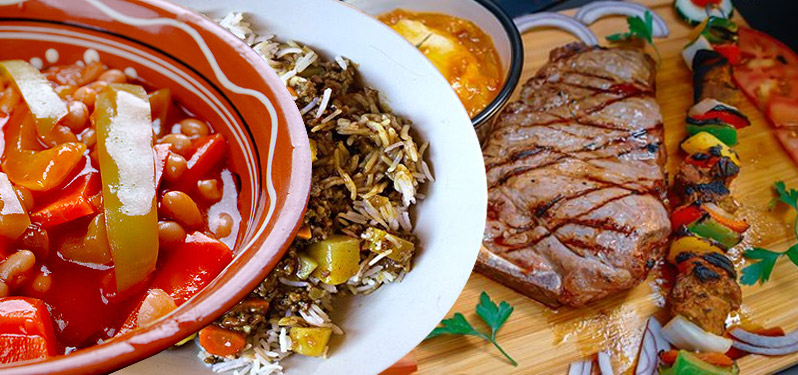
This traditional gratin is composed of spicy minced meat (curry, turmeric, apricot jam, raisins) surmounted by a flan with eggs and milk.
Although similar recipes existed in Europe in the Middle Ages, the Modern Bobotie was born from the Cape Malay community (the Malais of Cape Town) in the 17th and 18th centuries. Dutch settlers brought slaves from Indonesia, Malaysia and Madagascar. The latter have adapted European recipes by integrating their own spices, creating this sweet-salty dish that has become the national dish par excellence.- The Bunny Chow: The Ingenuity of the Indian Community
It is a hollowed out bread and filled with a meat curry or very spicy beans. The piece of bread removed serves as a hat and helps to sauce.
The Bunny Chow was born in the 1940’s in Durban, the city that is home to the largest Indian community outside India. During the Apartheid, Indian workers excluded from traditional restaurants were looking for a way to transport their lunch to the construction sites. Since plastic containers did not exist, they had the idea of using a loaf of bread as an edible and disposable container. The name comes from Bania, a caste of Indian merchants.- The Braai and the Boerewors: The social institution
The Braai is the South African version of the barbecue (with a wood fire), on which the Boerewors is grilled, a long traditional spiral sausage made of coarsely ground beef, pork and spices (cilantro, clove, nutmeg).
Its origin: The term comes from the Afrikaans braaivleis (roasted meat). The Boerewors (literally “farmer’s sausage”) was created by the Dutch, German and French Huguenot settlers (the Voortrekkers) who moved inland in the 19th century. They had to prepare supplies of transportable and easy-to-cook meat on a campfire. Today, the Braai overcomes all cultural barriers and brings together all communities.- The Biltong: The survival of the pioneers
These are slices of dried meat (beef, koudou, ostrich or springbok) marinated in vinegar, salt, sugar and spices (cilantro and black pepper).
Its origin: Long before the arrival of Europeans, the indigenous Khoisan peoples kept the meat by drying it in the sun. In the 17th century, Dutch settlers perfected the technique by adding vinegar and spices to be able to preserve meat during their long journeys across the country (the Grand Trek), at a time when refrigeration did not exist. The word comes from the Dutch bil (buttock/thigh) and flip-flop (language/band).- The Pap and Chakalaka: African and Mining Roots
The Pap is a very thick white corn porridge. It is almost always topped with Chakalaka, a spicy relish made from tomatoes, onions, carrots, peppers, chili peppers and canned white beans.
Its origin: Maize was introduced to Africa by the Portuguese and became the basis of the diet of indigenous populations (Zoulous, Xhosas). The Chakalaka was born in the 20th century in the Johannesburg mining townships. The miners, who had only very simple ingredients available, mixed vegetables with cans of tomato beans and spices to give taste and warmth to the traditional Pap.